Showing posts with label books. Show all posts
Thursday, September 27, 2018
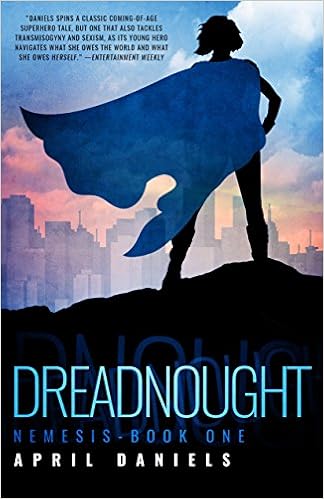
Dreadnought: Nemesis by April Daniels
This is a book that is likely to save someone's life. By having an openly trans heroine and her origin story, I can't help but compare it to the impact that X-men had on a lot of kids in the early days, that they could be outcasts from society or considered freaks and yet still be heroes or find acceptance for who they are. There are others who can and no doubt have delved into representation and why it matters with much more eloquence and insight than I ever could, so I don't want to focus solely on that, but it is an essential part of the protagonist's conflict.
We've all seen superhero origin stories before, and this one follows a similar pattern, but Daniels does it well enough and with enough empathy that I wasn't bothered by that. I couldn't help but feel for Danny as their home and social life collapsed around them due to a lack of acceptance and understanding. If you've ever seen the image of a survey saying essentially, "I want to protect it, I want to see it grow up and be healthy," that's the feeling that gripped me as I read through it. At some points things may have lacked subtlety, but with from the point of view of the protagonist, a relatively young outsider who is still trying to figure out how to express their true self, it's valid and feels like it fits in well in the four colored worlds of superheroes. It reminds me of the roleplaying game MASKS, in which even though the players are superpowered individuals that could jump buildings or bend steel, because they are young their personalities and characters are still in flux and in fact being heavily influenced by the adult presence in their lives.
There is a bit of freshness injected into the tried and true origin story with some discussions about legacies and essentially using child soldiers on the superpowered war on crime, and I would have liked to have spent a little more time on that. There were a few other places where things felt a little rushed, such as establishing the relationship with Danny's best friend, I don't feel like we spend enough time with them to have the impact that we should have by their behavior later on in the story. The other super characters besides Calamity and Doc Impossible end up not being explored much either. There are glimpses of deeper characterization for the side characters, but we simply don't get time with them before things come to a head.
In the end though, there's a reason that there's a formula to superhero origin stories, and using a trope isn't a bad thing if it's done well and lets us make those cognitive shortcuts to understanding a situation without needing additional pages of explanation. Dreadnought does it well, and the focus on Danny's emotional state makes her relatable as a character even if you don't share her exact struggles. And if this lacks anything in innovation of plot, it more than makes up for it in characterization for the protagonist and strong action scenes that I could easily see as straight out of a comic. So while not perfect, it's an exciting read and with its representation of a trans superheroine, as I said earlier, it's a book that could probably save someone's life.
Tuesday, September 25, 2018
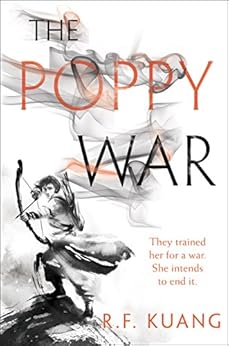
The Poppy War by R.F. Kuang
The Poppy War is a book that continued to surprise and delight me. First off, you don't need to have an understanding of Chinese history to enjoy this, but if you do, you will likely be jumping for joy every time you notice one of the people or incidents that this book draws from. A heavy dash of Eastern martial arts mixed with magic and exciting action scenes with an impressive outsider heroine in Rin that you can't help but root for mean that it can be enjoyed by its own, but the shadows of history loom large over this.
Perhaps at first, like me, you will read the beginning chapters and think to yourself, 'Aha! This is a gifted child at a School from Hell, there, I see the noble rival, and over there the smart bookish ally, and of course there is the eccentric teacher.' Perhaps you will think that this is that type of story, with that type of stakes, perhaps at the end they will graduate from this safe space, but for now-no. No, this is not that type of book, and the stakes raise from the fate of children to the fate of nations, characters fail and characters die and we learn very quickly that nobody is really safe, because the shadows of history are there and hungry.
This is a world heavily based on pre-WWII China, albeit with the things slightly adjusted, and the stand-in for Japan looms large over the story. Even as we explore the world and find the parallels to our own China, from the echos of the Opium Wars, Sun Yat Sen and the last Dowager Empress, to the Terra Cotta Army and others, both far too many to recite here, and many that I've no doubt missed. But the most important and most impactful of course is the Rape of Nanking. A pivotal moment that holds special meaning to me, as my paternal grandfather was involved in the recovery there after the war.
The book pulls no punches, and isn't afraid to show the horrors of war. The equivalent of gas attacks and military massacres are described in visceral detail, and the emotional impact on the characters, especially Rin is felt like a weight as she is pushed to the breaking point. I mentioned that characters fail and die, but they also grow, far beyond my expectations, especially in her classmates that at first I almost dismissed as schoolyard archetypes. And if the scenes described in the book are horrifying even on paper, I know that history, reality, was far worse. In another fantasy setting someone might say, 'no, this is too far, too dark, too evil even for villains' and yet, we know that these deeds were done, that there are records of Japanese soldiers laughing as they committed atrocities almost beyond comprehension. In the end, it helps us to sympathize with the cold choices that define our heroine, this is not the story where light will find some bloodless way to prevail over evil, there will be blood and sacrifice and hardship, and in the end a tough decision that in another story would alienate one from the protagonist, but here it doesn't, because the roots in reality and in history mean that people made similar choices.
It isn't perfect, the first half of the book is a bit slow, establishing characters and the school from hell. Well, we've seen this dance before many times and the the tonal shift once we leave the school can be a bit jarring. In addition, we're seeing things from a certain perspective, while it does a good job embodying a viewpoint, sometimes the nuance is lost. A final point, which is not a criticism, is that this is a book that may be difficult for some people to read, not because of its complexities or anything like that, but simply because it delves into topics that for a lot of people could be very traumatic. Abuse, trauma and atrocities are a recurring theme and one should be prepared to deal with that.
Overall though, I'm very happy to have read this book. There a vast richness of history around China and especially that period which western readers rarely encounter. There are plenty of books out there that will gleefully retell the King Arthur myth or the fall of the Roman Empire with a fantasy veneer, but there are precious few that will delve into the Opium Wars or the Rape of Nanking. The action scenes are top notch and I found the magic system quite fascinating to learn about, with mysteries still to uncover. I would recommend this as an excellent and refreshing change of pace, as long as you are okay with the content, because it doesn't pull punches.
Tuesday, January 10, 2012
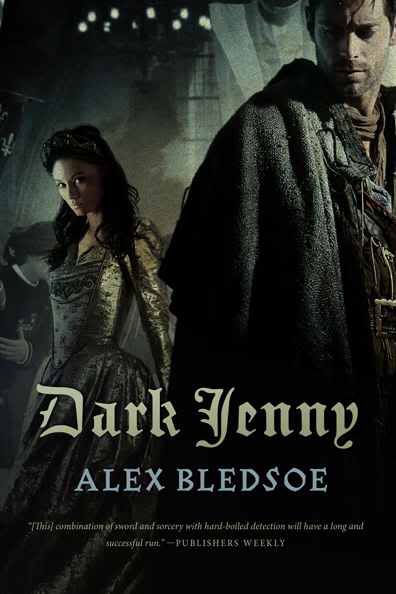
Dark Jenny by Alex Bledsoe
Dark Jenny is the third in Alex Bledsoe's Eddie LaCrosse series, now I've actually been thinking about how to review this, since to really delve into it runs the risk of spoiling all the little twists and turns that Bledsoe has added. On the other hand, given that the novel is a pastiche of Arthurian legend as seen through the eyes and grit typical of a LaCrosse story, we all know how it's going to end.
Alex Bledsoe set out to retell the King Arthur(Marcus Drake) story and fit it into the Eddie LaCrosse universe, where good women die and sell swords get the short end of the stick. Which really creates the conundrum of whether to take this as a story of Arthurian legend in LaCrosse's style, or an Eddie LaCrosse novel that takes place in its version of Arthurian legend.
Taking it as the former makes for a good story. Some of the tension is lessened by the framing device and the fact that we know the general results of the fiasco, however it's the journey that matters, and it's one hell of a journey. Although it seems that every author takes their shake at rewriting the myth, what shines here are the well written characters that evoke love, hate, or awe, which are one of Bledsoe's strengths. These characters that we know from the legend are brought to life in a way that is quite fitting with the atmosphere of the LaCrosse universe. There are of course the trademark anachronisms that populate the LaCrosse universe, their version of Merlin for example throwing in a nice bit of levity into the book. And the twist on the tale that is woven into it is both respectful to the tale and logical to the fantasy noir nature of the novel. By itself, and in that respect it is well written and a novel take on the King Arthur mythos.
Viewing it as an Eddie LaCrosse novel is where I have a few issues with it, if only in comparison to contemporaries and to the other books in the series. The genre of fantasy noir, or the dark mirror of urban fantasy(perhaps fantasy urban? urban elements in a fantasy world) has certain authors that have put their mark on it. Glen Cook's Garrett PI series for example, or Martin Scott's Thraxis series, a benchmark that the first two Eddie LaCrosse books have met or exceeded. One of the features that crop up however, is a general progression of world and story, an accumulation of allies and enemies, and by virtue of the framing device of Eddie telling the story over drinks, we really don't see much of that. It's a recounting of a chapter that is now closed, and as such feels almost independent of the greater Eddie LaCrosse universe. In another series I would say that this makes it a good entry point for new readers, but the first book of the series is simply so strong that I would always recommend them to start there.
In the end though, it is a strong retelling of the Arthur tale in a fantasy noir style and with a good dose of both grit and playfulness. On the other hand it doesn't actually advance Eddie's life much and can likely be read out of order without too much worry. If you've been following the LaCrosse series then go ahead and get it, you'll enjoy it. If you haven't been following the series, start at The Sword Edged Blonde, and move on from there.
Wednesday, December 28, 2011
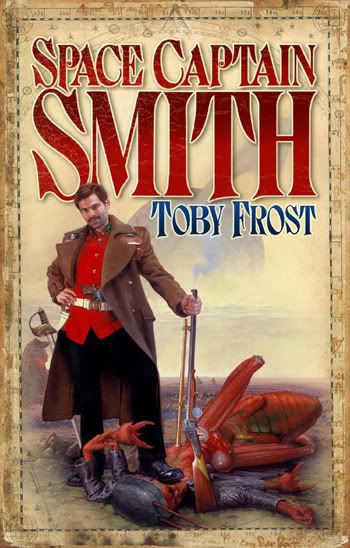
Space Captain Smith by Toby Frost
Space Captain Smith by Toby Frost is the type of rip-roaring adventure that you didn't know you were nostalgic for. A ship, a crew, a stiff upper lip, and they're off to save the galaxy for England! Well, except for the fact that it's a rust bucket, there's an air of Flashman about him, and the most dependable member of the crew is the space hamster. Yes, they went there.
The story spares no expense at poking fun at various archetypes and films, including an extended reverse Blade Runner sequence, a visit to the Matrix, and a lovely send up of the Proud Warrior Race/Noble Savage. Really, one can tell that Frost enjoyed themselves in writing this book. Without that the story itself would have fallen a bit flat, but the jokes and parodies abound and the characters are quite the entertaining assortment that's essential to these space romps. I call it that purposefully, because it's hard to call this a Space Opera, given the lighthearted tone of the novel.
The British humor and sometimes campy characters make this a light and entertaining read, while still having a nice chewy center for those wanting a space yarn in the style of say, Firefly in its less serious moments, or Edgar Rice Burroughs through a fun house mirror. The Colonial attitudes are played for laughs, the "White Man's Burden" to educate the aliens and teach them how to brew a proper cup of tea.
Now, I have to say that I quite enjoyed it, but I'm sure it's not everyone's cup of tea. And there were parts that went from delightful gag to old quick, the aforementioned Blade Runner and Matrix nods, the laughs from them were often accompanied by groans. Still, a solid book, especially if you've read all too many space operas that couldn't sit back and laugh at themselves. Pick it up for some lighthearted reading, dashing adventure, and British humor.
Friday, January 28, 2011
In Hero Years...I'm Dead
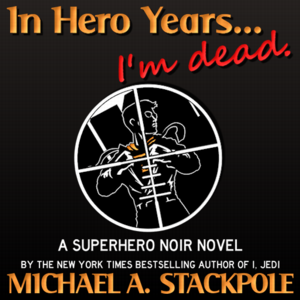
In Hero Years... I'm Dead by Michael A. Stackpole
One of the latest out by Stackpole, available from amazon or his own Stormwolf store through the link above. There are two ways to look at this, as a Stackpole book, or as a Superhero book. Now don't get me wrong, I usually quite enjoy his work, but as I've mentioned before, similar themes tend to resurface. In this one we have a Revenant, a warrior who has been away for years only to find everything has changed on him, twisted genealogies, and quick witted protagonists. I kept on comparing the book to Once a Hero or Talion or the Chaos series in my head while I was reading it. But if you enjoyed those books, then it'll deliver as expected, stunning fight scenes, witty dialogue, and cunning heroes.
Now, to look at it as a Superhero book, well that's where it tends to shine. If you've ever read Kingdom Come and wished for less of a biblical feel and more of a street view, then this is for you. It delves into the mentality of being a superhero versus being a real hero, of the obsessions and problems that they face, and what the various iconic heroes represent. It's also about legacies, can a hero or villain pass the mantle on to their heirs, and if so, is that really a good thing? It is an interesting world, but not as dark as it could have been. How can someone who still believes that to be a hero is to help people-live in a world where heroics have morphed into a mix of entertainment and sports betting.
It's a unique and entertaining take on the superhero genre, the themes may not be totally new, for people who are familiar with Kingdom Come, Watchmen, or even Soon I Will Be Invincible, but the action is crisp and characters are well fleshed out, while still embodying recognizable superhero archetypes. In the end, even with all the little gripes, I can make one great piece of praise that trumps them all...it was a one sitting book. I sat down and started reading, it wasn't until about 4 or 5am that I looked up from the ending words. I'm definitely happy to have picked it up.
Thursday, October 29, 2009
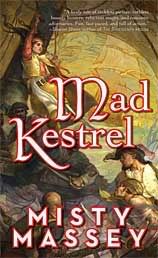
Mad Kestrel - Misty Massey
A swashbuckling tale about pirates that has surprisingly little actual piracy. Kestrel is a natural magic user in a world where magic is highly regulated, with "promises" or those with talent taken away by a shadowy society of mages. She runs away and finds that saltwater runs in her veins, taking up as the quartermaster to a pirate ship.
This book just didn't quite hit the mark with me. Perhaps it was the pacing, it started out relatively slow, but had a steady buildup, and as it approached the end I kept on thinking to myself "There has to be a sequel, it can't tie up everything in these few pages left!" The climax and ending was like a cannon shot, sharp and short. Even though the story had been building up to that moment, things came together in a single burst of action and it was over with. Or perhaps it was the lack of actual piratical activities, the only ship that they take is essentially their own ship in harbor, all others are merely past references, in fact, I don't believe that there was actually a cannon shot in anger, the closest we get is a warning shot across the bow.
The characters are also a mixed bag. The most loveable ones, such as Kestrel's friends from the bawdy house and of course Binns, tend to be out of the picture much of the time. They also tend to be solid archetypes, but with a few secrets to give them a bit of depth. Some of the crew is given life by their actions and descriptions, and that's something I would have liked to see more of, but for the most part they were rather forgettable. McAvery, the dashing rogue, is, well, there isn't much to him that doesn't appear on the label. Or at least if there is, he doesn't show it, he's there as a foil and romantic interest. I couldn't help but imagine him always having a self satisfied smirk while he plotted out how to get into Kestrel's pants. Add in the fact that he knows and exploits Kestrel's attraction to him moves his actions from romantic over to creepy in my opinion. Kestrel herself however, I couldn't help but like, she's a flawed heroine, and that shows through her internal biases and impulsive nature. And even though there were times when I wanted to slap her for being an idiot, I couldn't help but admire her guts and determination, as well as her quick thinking.
Mad Kestrel by Misty Massey was enjoyable, but plagued by inconsistent pacing and characters. It was also not quite what I expected, being more of a character based book, with piracy being almost incidental to the plot. There was so much potential there for a really wonderful book, but most of it is just not utilized. All in all, Mad Kestrel won't blow you away or give you a "wow" moment at the end, but if you've got a nice rainy afternoon then by all means go ahead and give it a go.
Sunday, October 18, 2009
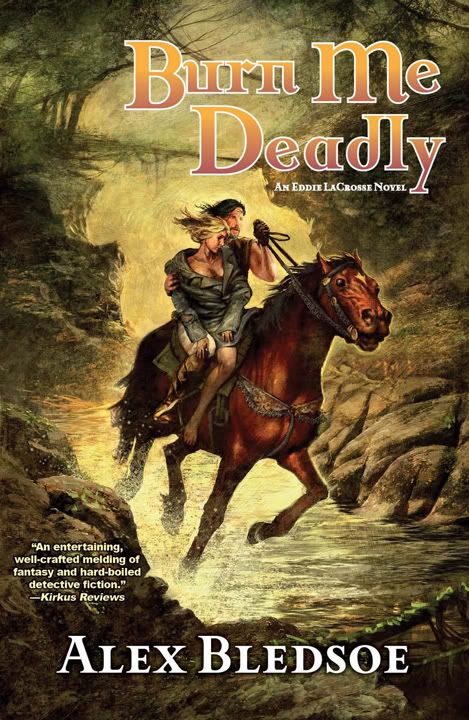
Burn Me Deadly - Alex Bledsoe
There's always the question of whether the sequel will live up to the original, especially when the first is as powerful as the Sword-Edged Blonde was, but I have to say that I was not disappointed at all with Burn Me Deadly. Fair warning, there are going to be some spoilers in this review.
Burn Me Deadly does have a change of flavor from the original, in that it is what I'd call a setting book. In the Sword-Edged Blonde, Eddie traveled far and wide to uncover mysteries, now we explore his home base and the area surrounding Neceda. Something that Bledsoe does quite well is interweave the stories of the people that in other books might fade into the background, or be conveniently pushed offstage when the plot doesn't need them anymore. Such as the wandering scribe who is most definitely on his own mission, the anti-government survivalist family, or even the guardsman that threatens to move in with Eddie and Liz if he gets fired. Little details like that turn this into a living world, admittedly one that's situated in the backwoods and lonely hills. Ones inhabited by a dragon cult that is at once exotic and rural, more evocative of serpent handlers in a backwoods church than of the bloodthirsty fanatics usually encountered in fantasy worlds.
Now there were a few moments that brought me out of the fantasy. One of them being a trick sword in a scene that reminded me of the movie Blade. Now it was nice to learn a bit more about the swords now that we know that them having make and brand names isn't just a one off joke, but the "special grip so it doesn't slice your hand open" gimmick was a bit much. This was a relatively minor problem though as anachronistic elements were tossed in every now and again, mostly for comedic effect, so it wasn't glaring.
The real gem of this story was in learning about the characters and relationships between them. Eddie and Liz's relationship have a very real and mature feeling to it, of people who genuinely care about each other, and aren't the young starcrossed lovers you usually see in fantasy.
While the body count has gone down, it still retains that deadly edge which keeps you on your seat. Good people(and horses) die, and not all of them die in epic battle, there isn't that aura of invincibility that usually surrounds well liked characters, which I think is necessary if a rather gritty fantasy like this. Anyways, Burn Me Deadly by Alex Bledsoe proved to be another great read, it has a stronger emphasis on setting than its predecessor, but proves to be every bit as entertaining.
(Note: This review was on the ARC copy, as such there may have been changes between it and the print version)
Tuesday, September 1, 2009
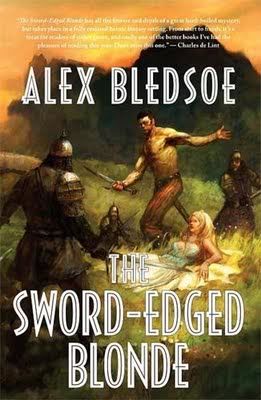
The Sword-Edged Blonde - Alex Bledsoe
Just finished reading and all I have to say is wow, a very impressive entry from a newcomer. First let me give you the brief, relatively spoiler free background.
Eddie LaCrosse is a sword jockey(read PI) living over a tavern that's seen better days. A routine assignment to find a wayward princess turns his life upside down as he's pulled into a murder mystery that spans across decades. Eddie must now try to save the wife of his best friend while confronting his own past, which may just be more horrifying than the apparent grisly murder.
Now that's just scraping the surface, to tell more would definitely edge into spoiler territory, but how its written is something to behold. The book reminds reminds me of Glen Cook, if he had written his Garrett PI books in the same manner as The Black Company. Grim and bloody detective noir mixed in with a liberal dose of fantasy and magic. People die bloody and sometimes senselessly, and trusting in the kindness of strangers is a good way to end up with a dagger in your guts. The good guys have feet of clay and the bad are downright nasty, and sometimes there's a reason.
Eddie is very much in the mold of a grim fantasy hero, old and scarred enough to have gained a healthy dose of cynicism, but still noble where it counts. And we come to see his inner journey, reliving his history and coming to terms with what he's done, is just as important as the present predicament. The rest of the cast comes through in spades, full of interesting individuals whose personalities shine through whether they are a recurring character or ones that only pass through, leaving their indelible scars upon the story. The characters were definitely the high mark of this novel, and I hungered for more.
As for the setting, it takes a bit of a backseat to the journey. It's also filled with some rather anachronistic elements, which I found humorous but other people might find rather jarring for their fantasy. These included things such as; nametags for tavern girls; customs at the border crossings; and swords being issued model names. Again, funny, but a little bit jarring if you're expecting straight up fantasy. But if you're used to the cross genre detective fantasy present in, say, the Garrett or Thraxas series, then this is definitely on that vein.
In all, this is an excellent example of its type, and one that I thoroughly enjoyed, pulling me in so fully that I only lifted my head up hours and hundreds of pages later. There are a few points where willful suspension of disbelief is necessary, but other than that I found no real problems with it, and hopefully we'll soon see more of the Eddie LaCross series.
Wednesday, January 28, 2009
Legion - William Altimari

Flashing swords, mysterious barbarian women, and the glory that was Rome. All the ingredients for a fine historical novel. Well, first off, why, oh why did they decide to put the ENTIRE PLOT on the backcover blurb, I mean, Rise and Fall of the Roman Empire is common knowledge, but did they need to reveal all the details? In fact, the biggest twist reveals are right there, there is not even a semblance of surprise to be had. Now, that's not a book killer by itself, so lets get to the meat of the book. Hopefully with a minimum of spoilers.
The author introduces us to the Roman world through the Greek-Diocles-a convenient mouthpiece that tosses soft ball questions to the soldiers and officers of the Legion. And inevitably we end up with page after page of various characters extoling the virtues of Rome. Now, I'm not going to deny that Rome was the top dog civilization with advanced weapons and tactics, but do we really need to hear about it every third page? Especially once Superma-I mean Centurion Rufio turns up, a better woodsman than the natives, can take on trained killers without a scratch, an marksman without equal, leaps tall Gauls in a single bound! Rome personified, standing between the unwashed(literally) Germans and the fabled cities of Rome! With a surprisingly modern morality, about two millenia before its time, freeing slaves, and spending most of his life redeeming himself for what was more or less an accidental killing during battle. Can we lay it on any thicker here people?
On the other hand, it wasn't all bad. If you can swallow all of that without gagging too badly, the book is actually a pretty easy read. Or at least I was hooked in by the rattle of arms and armor, the dust kicked up by sandaled feet, and flashing swords of some red blooded battle sequences. Now, if Altimari had focused on that aspect, as opposed to Rome/Rufio being the next best thing to the savior of civilization, then things might not have been so bad. The "mysterious barbarian woman" who is really no mystery at all due to the back blurb also provides some good moments, along with the overly sappy ones that follow. Random love story in a time of war, sometimes it works, sometimes it doesn't. It was nice to have the interlude, but it could have been easily toned down, going from sappy romantic interlude to battle, well...jarring to say the least.
There are better books out there about the same subject matter. This one isn't horrendously bad, but it can easily be skipped. The area where it does the best in my opinion is the description of Legion life, and a quick trip to wikipedia will save you the purchase price. Nice for some escapist afternoon, but no need to search this one out.
Thursday, July 3, 2008
The Dragon Never Sleeps
The Dragon Never Sleeps - Glen Cook
Canon space has been ruled for thousands of years, overseen by immortal Guardships, ready to dispense justice and restore order with extreme prejudice. But the years have taken their toll, and for the crews, constantly undergoing a rebirth cycle to rival any karmic wheel, and the nascent AIs, things are not what they once were. Whole ships have gone silent, prowling about the uncharted rim, seeking the mysteries of the web, and worse, some have gone insane. Some are no more than ghost crewed flying dutchmen, while others have turned into dictatorial fiefdoms, and even the other ships fear their presence. Canon space has changed as well, what was once a human empire is a decaying husk, aliens, clones, and artificial constructs battle with rebel agitators and trade families to carve out their own pound of flesh.
Only one race challenged the Guardships for supremacy, and they have entered into the realm of myths and legends. The Ku recreated themselves into perfect soldiers and tacticians, adapting their race for one thing, the war, and even they were wiped out, except for one. After a hundred generations of rebellions rising and falling, the Ku's last and greatest general has resurfaced, and the time for vengeance has arrived.
But there are other things out there, things more horrible and strange than even the insane AIs of the Guardships. Aliens from beyond the Rim, and they look with hungry eyes on the bloated jewel of order known as Canon Space.
Let me first say, I am a fan of Glen Cook, from his Black Company to Garrett PI books, I've devoured them. And this one is no different, I would compare it to his Dread Empire books, with intricate plots and powerful, sometimes mysterious and unexplained forces pushing schemes within schemes. That said, I've only given the bare outlines of the plot above, but believe me, I couldn't explain it all without reams of pages, not to mention spoilers galore, best is to simply read the book.
As for the book itself, some of the description is a bit sparse, but Cook is able to do quite a bit with a few words, creating the atmosphere of a scene so palpable that you can feel the bulkheads. This is Space Opera at it's best, while still being somewhat believable. There aren't any immortal heroes(resurrected, yes, immortal, no) that right the wrongs of the universe, like the Black Company books, the Guardships have definitely drifted into the gray area of morality. With believable, if somewhat insane, characters, and a twisting plot, this is one of the few books that I can say that I didn't have a clue what would happen even as I turned the page. When I was finished there was that "oh wow" feeling that one gets after reading mindblowing literature, but also a hunger, that there could have been more, especially in the last few pages. But still, this one gets my full recommendation.
Wednesday, June 11, 2008
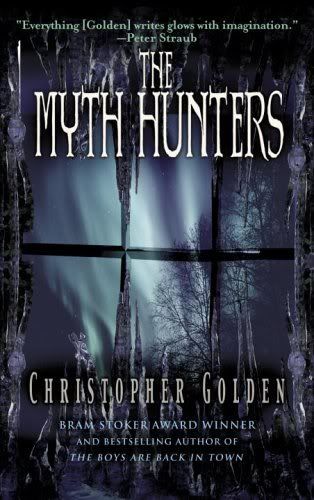
The Myth Hunters
The first in the Veil series by Christopher Golden, the Myth Hunters evokes images of Gaiman's American Gods or China Mieville's King Rat, with fantastic myths and legends living in a mirrored world of fantasy. The book follows some pretty classic fantasy tropes with the reluctant and somewhat bewildered hero thrust into a land of gods and fantasy. But these aren't always the myths we remember, more often than not they're the ones that originated in the bloody past, primeval things, uncaring for mortal lives.
The protagonist, Oliver Bascombe, is torn from his everyday life by a near death Jack Frost. Accompanied by Frost and the enigmatic and exotic Kitsune, they set out to find what has been targeting the Borderkind, those personifications of myth that can cross freely between the worlds. While on the other side of the veil, his sister and fiancee search desperately for him. Once the Sandman is freed however, the ante is upped, with his sister imprisoned in a dungeon of sand and his fiancee and a detective on the trail of a serial killer with a disturbing pattern.
Anyways, that's enough of an overview without revealing too much of the plot. First off, the writing is excellent, pulling one into the scenes and portraying the characters in a very believable manner. Which is quite a difficult thing to do indeed when one is encountering mad gods and legends. The only trouble I had with the novel was that there was a definite change in tone as the story switched between the various characters. So while at some points it felt almost like fantasy, other portions could be horror or mystery themed. However, I found the effect worked out in the end, as the separate plot threads weaved their way closer together. Overall, an excellent work, with good pacing and wonderful characters. If you have a taste for the myth as reality genre then this is a book for you.
Labels:
Book reviews,
books,
Christopher Golden,
The Myth Hunters
Wednesday, May 7, 2008
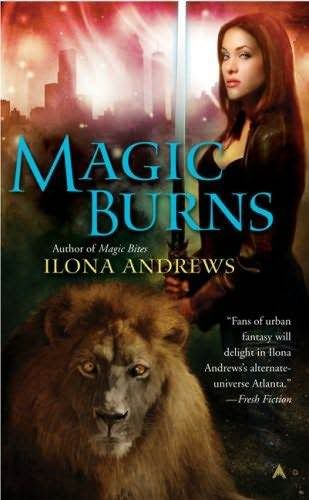
Magic Burns - Ilona Andrews
"Bring your army little god! My sword is hungry!"
Magic Burns by Ilona Andrews is the second in her Kate Daniels series, set in a world where Magic came back, ending, or at least highly disrupting the reign of technology. However it comes and goes, ebbing and flowing like the tides as the magic returns into the world. Not only does the magic bring power, but it transforms the world with its abilities, and when the magic is in control, everything from phones to cars shuts down, not to mention skyscrapers.
The heroine Kate Daniels is a mercenary working for a modern day version of the Knights Templar(called the Order), toting a flesh melting sword and a take-no-shit attitude. Which has all the makings of a good Urban Fantasy story. World shattering danger? Check. Summoning of elder gods or in general things MAN WAS NOT MEANT TO KNOW? Check. Vampires and Werewolves? Check. Magic? Check. Sword slinging violence? Check. Sexy situations? Double check.
The world itself makes for some interesting twists on what you usually see with your urban fantasy. Instead of the "Magic was hiding" or "It was there all along" types that you usually see, often accompanied by all sorts of 'don't tell the normals' rules and regulations, we have magic and tech as a pendulum, swinging back and forth(Actually, the first thing I thought about was an association with global warming and cooling periods and solar cycles, but I don't think that's exactly what she had in mind).
Secondly, the coming of magic wasn't something that just shocked the world, it shattered it. The most obvious example being the Atlanta skyline, full of ruined towers and fallen buildings, not quite post apocalyptic, but you get the feeling that it felt pretty close. Although it does have what seems to be the trend in having scientific viral explanations behind the main monster staples(vamps and weres), the Vampires are not the sexy seducers you find in most urban fantasy. Mindless, putrefying, and bloodthirsty, and hopefully under the mental control of necromancers, who are in return hopefully under control of the law. There was a hilarious line about how to make a Vampire being a dozen forms and a stack of applications.
The heroine is instantly likable. Ready to kick ass and take names, with practicality and doing right at the top of her list. And unlike some female heroines in urban fantasy, doesn't get sidetracked by sex. There are steamy situations, and it almost seems that for all her protestations about not getting any, every other person is ready to jump into her pants. However the sexual aspects don't ever become the focus of the story-something which always tends to turn me off a bit to a book. Not to mention quoting lines of cheesy movies, and despite death everywhere she doesn't become flooded with existential angst, another danger of the genre.
The other characters are also interesting. I just have to give props to the heroine's coworker Andrea at the Order for excellent pistol choice(she carries SIG226s if you're wondering). Sorry, inner gun nut coming out, anyways, every one of them have at least an interesting quirk that make them stick in your mind. However it felt very uneven in how they were covered. Perhaps it's just because of the long time it's been since I read the first book in the series(Magic Bites), but some of them don't appear long enough to get more than that single quirk. For instance, Saiman appears for a single scene, and later is referenced to another character simply for that trait(wanting to bed the protagonist). They come on stage and then disappear just as quick. Now if you know them from the first book, then you won't need any explanation, but I could easily see losing track if you didn't have at least some foreknowledge.
One of them really stood out for me, Bran, a warrior from another age who made the unwise choice of making a bargain with Morrigan. I'm trying not to give too much of the plot away, but suffice to say, it was like seeing a character Robert E. Howard or David Gemmell could have written about, but all barbarian, no heroism.
Now I have to admit, I'm a sucker for good Urban Fantasy, and that is what this is. Between getting in into my grubby little hands and turning the final page I doubt more than 4 hours passed, including the ride back from the bookstore. So it quite definitely has my recommendation, with the reservation that you really should read the first book of the series before this one. As I mentioned, some recurring characters really should be known about beforehand, and some of the explanations of the world are only glanced at during this book, whereas they're more fully explained in the first. Also, it tends to jump around, the fact pacing and quick action sometimes left me feeling like some scenes were cut short where they could have lingered a bit longer.
Anyways, the Kate Daniels series by Ilona Andrews is top notch urban fantasy, right up there with the Dresden Files series by Jim Butcher or the Kitty series by Carrie Vaughn, and you would do well to jump in while it's still early in the run.
Monday, March 17, 2008
Land of Mist and Snow
Take one part Frankenstein, one part Lovecraftian horror, a dollop of Moby Dick, and a dose of Horatio Hornblower, and set it all during the US Civil War, and you might get something like this. The premise is more exciting than the story itself, a demon raider prowls the shipping lanes as a US naval ship built to mystical specifications launches to sink her.
Unfortunately, in my opinion, it lacks in the execution. The plot and characters are predictable, and the diary format, while it allows for different points of view, just doesn't convey the emotions and urgency of the scenes. In fact there are several characters that blur together due to this, as the writing is similar enough that you have to look closely to see who is actually being represented. Though a I ended up using this little cheat, if they believed strongly in freedom, it was one of the main characters, if not, then they're likely going to die.
We start out with our eager Ishmael/Hornblower character in Nevis, and our Frankenstein/Herbert West/Ahab in Captain Sharp. Who harnesses a spirit to guide their ship in the search for their Confederate counterpart(which runs on blood sacrifice), all the while quelling dissent by slowly but steadily turning the crew into zombies. The romantic subplot with Miss Abrams and Lt. Nevis is, well, you can tell the due course of that from the moment they meet, the foreshadowing is beaten into your head with a stick. And the rest of the cast are more or less, forgettable. The climax is more anticlimactic, and we have a typical all lived happily ever after ending, which I found quite disappointing.
On the other hand, it does have some interesting naval action, though more or less lopsided due to the nature of the ship. And it moves at a pretty fast pace, due perhaps to the fact that they skip ahead with the diary entries quite a bit. But really, that isn't much to recommend it. Personally, I'd say to save yourself the cash and pass this one by, it looks a lot more exciting than it really is.
Sunday, February 24, 2008
Off Armageddon Reef - David Weber
There are two ways of looking at this book from the perspective of one who's read quite a bit of sci-fi. Either it's a good addition to the volumes on this particular topic, or else it's a not to inventive retelling of a familiar theme. I'd like to lean towards the first, but there's no denying that this story will be familiar to readers. At it's base we have the Connecticut Yankee scenario, civilization has fallen on the colony world and the main character is ready to bring it back up to its space faring roots. The first few chapters lay the groundwork of what has come before, and I'm tempted to say that it's the most heart filled part of this tale, as the alien exterminators crush the last human resistance save for one small fleet, ark ships sent to establish a colony and go on low tech silent running to evade detection.
Once they get there however we have something that could have come out of Zelazny's Lord of Light, a split between those who would set themselves up as gods of a permanently agrarian pre-industrial society, and those who want to keep the knowledge of what has come before alive so that their descendants can take back the stars. Needless to say, the deicrats win, even though the techies manage to squirrel away one of their android bodies(along with a few high tech goodies) for 500 years or so. And now we awaken a living computer to guide humanity back to the stars(The General Series by David Drake), keep the barbarians from sacking what may be the last bastion of civilization(Lest Darkness Fall, L. Sprague De Camp) holding out against a violently anti-tech mother church and the added complication of an orbital space array set to destroy any telltale emissions(Greatwinter Trilogy, Sean Mcmullen).
We of course go through our checklist when encountering a more primitive society you wish to bootstrap up. Gunpowder? Check, they already have that but the protagonist introduces a better mixture. Rifled Weapons? Check, as well as Mine Balls. Better Ships and Cannons? Schooners, Galleons(the current navies are anchored on rowed galleys) and cassions. Cotton Gin? Check. And so on and so forth. As Nimue, now in her gender bending role as the teacher Merlin guides the fledgling kingdom(And yes, Excalibur makes an appearance as a machine forged sword of 'battle steel').
There are a few places where we get interesting factors in play, such as Nimue being schooled in the Japanese sword arts and trying to teach that to essentially medieval Europeans. As well as the aforementioned gender bending...but otherwise it' simply a rather predictable grind. Not that the grind isn't enjoyable of course, Weber definitely knows how to write military fiction, and learning how Nimue deals with the next ordeal was enough to keep me interested. However some of the other characters fall flat, especially their antagonists, are pretty archetypal, and I found myself skimming while their parts came up, or when it discussed their religious structure, an undisguised take-off on Catholicism. Which is a little strange in itself as the early discussions feature ancient Egypt as the historical near ideal for a static society(Which I'm not sure I agree with, as opposed to perhaps a far eastern Confucian example, but we digress).
From Bring The Light by David Drake, to A Fire Upon The Deep by Vernor Vinge, one wonders if this bootstrapping of technological progress should have a genre all its own. As it is, this addition to the type doesn't really have any portions that I can point out as especially bad, but nor does it have many extraordinary qualities either. Good writing, but it feels like we're just going through the motions, without anything "special" to make it stand out, the exciting story makes up for this, but there really isn't much tension. When you're a neigh immortal android body, waiting another century or two of stony sleep isn't that terrible of an idea as it seems that technological progress was beginning to seep in through the cracks anyways. Her motivation being to stop a holy war, but one that most likely won't destroy civilization on the planet, so it's very hard to see the urgency that she seems to feel.
Anyways, solid work, but predictable and made less forgivable given that Weber has already written on this very topic in Heirs of Empire, which in my opinion did it better with more sympathetic characters and in about half the length(Off Armageddon Reef weighs in at about 800 pages...and promises to be only the first in the series given that they hadn't even made any steps towards working around the orbital bombardment/sword of damocles over their heads). I'll pick up the next in the series, but it probably won't be a priority for me.
Monday, January 28, 2008
Sun of Suns - Karl Schroeder
"And for some reason, the thought that Admiral Fanning was dead, or soon would be, was no consolation. Who cares about him? some unexpeected part of him said. Only you, and what do you matter?"
-Karl Schroeder, from Sun of Suns
Hayden Griffin has just seen his family and his homeland destroyed at the hands of one Admiral Fanning, and swears revenge. A basic premise for any fantasy or space opera, except of course for the fact that he lives within a fullerene balloon(a dwarf cousing to a Dyson Sphere) and that his parents were killed because they were trying to create a sun. And now, after years of hatred and revenge driving him, what happens when he realizes that perhaps, the Admiral is not the monster he is believed to be.
Mixing a classical set of fantasy tropes with some surpising use of hard science, this makes what could have turned out to be a tiring rehash into an interesting and enlightening read. Heated by a central sun as well as smaller peripherary suns created by nation flotillas of wheeled towns and cities(the wheel is the basic shape to create more than microgravity), the space between becomes a sea with ever moving landmasses. And of course Winter, where no light penetrates through the clouds, and Sargassos where the air has gone stale and toxic, deadly to all without their clockwork space suits. Because of certain factors, which I won't tell for fear of spoiling the book, there is a mix of advanced and primitive technology at work, kerosene powered jet bikes for short range travel, and large wooden hulled sailing vessels ply the tradeways.
It feels like Schroeder has created a fully realized world, one with history and myth, as well as wonder and danger. The sciences of the cloud formations seem quite well thought out, though as I am no meteorologist I can't give more than a "it makes logical sense to me" opinion. The whole politics of nations in orbit around each other is something that is quite interesting, something that few other books have tackled.
The book reads like naval fiction, set in a space opera backround and a steampunk spirit with hard science added into the mix. I for one am looking quite forward to the second book in the series, but either way it's an excellent read. Perhaps not for everybody, but if you keep an open mind coming into it then I believe most will enjoy the vivid scenes that combine the otherworldly and familiar. Sun of Suns has my recommendation.
-Karl Schroeder, from Sun of Suns
Hayden Griffin has just seen his family and his homeland destroyed at the hands of one Admiral Fanning, and swears revenge. A basic premise for any fantasy or space opera, except of course for the fact that he lives within a fullerene balloon(a dwarf cousing to a Dyson Sphere) and that his parents were killed because they were trying to create a sun. And now, after years of hatred and revenge driving him, what happens when he realizes that perhaps, the Admiral is not the monster he is believed to be.
Mixing a classical set of fantasy tropes with some surpising use of hard science, this makes what could have turned out to be a tiring rehash into an interesting and enlightening read. Heated by a central sun as well as smaller peripherary suns created by nation flotillas of wheeled towns and cities(the wheel is the basic shape to create more than microgravity), the space between becomes a sea with ever moving landmasses. And of course Winter, where no light penetrates through the clouds, and Sargassos where the air has gone stale and toxic, deadly to all without their clockwork space suits. Because of certain factors, which I won't tell for fear of spoiling the book, there is a mix of advanced and primitive technology at work, kerosene powered jet bikes for short range travel, and large wooden hulled sailing vessels ply the tradeways.
It feels like Schroeder has created a fully realized world, one with history and myth, as well as wonder and danger. The sciences of the cloud formations seem quite well thought out, though as I am no meteorologist I can't give more than a "it makes logical sense to me" opinion. The whole politics of nations in orbit around each other is something that is quite interesting, something that few other books have tackled.
The book reads like naval fiction, set in a space opera backround and a steampunk spirit with hard science added into the mix. I for one am looking quite forward to the second book in the series, but either way it's an excellent read. Perhaps not for everybody, but if you keep an open mind coming into it then I believe most will enjoy the vivid scenes that combine the otherworldly and familiar. Sun of Suns has my recommendation.
Friday, January 11, 2008
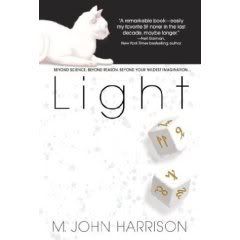
Light - M. John Harrison
"As a matter of interest, why did you murder all those women?"
"To keep you away from me."
"Oh dear. Didn't you realize it wasn't working?"
-from Light, by M. John Harrison

This is a crossposting of a review I had up on my other blog, but A. It fits better here, and B. I'm lazy and want to get content up.
Well, I just finished reading Light, by M. John Harrison this morning, or late last night if you prefer. It was a book that I picked up and put down twice, getting a chapter or two in before putting it down and wandering off, only on the third time did I stick it out because I felt deep down that there was a great prize in reading through this mystery.
It follows three people intersecting in time and space, and every one of them is peeled back in layers of pain and ennui, either way, they're all varying degrees of fucked up. The first is a software engineer who is working on a quantum computer, no, actually he's a serial killer targeting women, well, actually he's a man fleeing a codependant relationship, but it truth it's a monster with a horse skull for a head that he stole a set of dice from, and he uses those dice as a divination guide through life that led him to see the possibility of a quantum computer...you still with me here?
Secondly there's the White Cat, Seria Mau, or Seria Mau and the K-Ship, White Cat. You see she's the brain in the ship, literally. Not only that, she stole it from the military. Of course, the ship isn't really military, it's a shell of a ship hacksawed to fit in this alien artifact so they can hook it up to human technology and jack in a human controller. If you've ever read any of Anne McCaffrey's "Ship who..." series then you know the gist of it. Of course, she's also a little girl whose mother died when she was young and her father did his best to turn her into a replacement for the dead mother...with all the ickyness that entails. Oh, and the process of hooking one up to the tech makes you schizophrenic, well, not really, since there really is an alien presence speaking with her mind. She is now, among other things, a pirate.
The last one is Ed Chianese, we're first introduced to him as a twink, not what the current definition would be, but a future one. He goes for weeks into full body immersion tanks to experience a 3d fantasy world where he stars in a bigger than life detective drama, heavy on the gratuitous sex and violence. After all that's taken away from him we find out that he was once an infamous pilot pulling daring raids into the void and around the Beach. The Beach is a sort of tidal area around a section of space that essentially defies all explanation, hundreds of civilizations came to try and understand it, sometimes dragging whole planets around to get a better view, but in the end they died out just as easily. Which means that there's a lucrative business with salvage. Of course, beneath the death defying flight jockey and the burnt out pleasure junkie is the little boy who didn't understand why his sister left him and his father alone after their mother died.
In the end their stories get twined together and wrapped up with, what I felt, was an overabundance of handwaving and saying "Aliens did it." actually just one godlike alien who designed everything from the beginning to create their set of circumstances. It felt lacking, there were time paradoxes that I felt could have come together neatly, strings that could have linked up nicely, in fact none of the three characters actually meet each other except as, well, bones. I felt disappointed at the end, it was not what the beginning and brilliant middle of the book promised. Of course, the only characters really with soul happened to be the side characters.
On the up side, as I mentioned, the setting was brilliant, beautiful, and I wish more time had been spent on it. The post-frontier town era that plagued the beach, the use of 'fetches' part hologram and part nanotech cloud to communicate, the rickshaw girls, genetically engineered so they could run and carry the cart from birth to death(2-4 years or so), the one time 'cultivars' or grown clones where you could download your personality and be whatever the gene techs could splice for you. Then there were the New Men, aliens who visited Earth and conquered it, of course they weren't very good at it, and within a few generations they were the universal garbage men and quick-e-store clerks, unable to fit in and compete in a human world.
Two other themes stood out among the characters, one was a twinned facination and disgust with sex, and the other was a callousness about life. The killer of course has encounters with the women, and with his ex-wife, where he really isn't interested in intercourse nearly as much as seeing her vulnerable and, well, fucked up from her own psychological issues of anorexia and the fact that she's sleeping with a killer(and won't let him leave her). Seria Mau watches her passengers with a lurid voyeurism, until she gets annoyed at them and vents all except one into space. That one too will die along with the other person who ends up helping her, marooned on a viral planet. And finally for Ed, years of VR has ended up with him reacting to women only as sex objects, the exception being the rickshaw girl that he saves who is also somewhat of a mother figure, until her own psychosis sends her to a body shop to be turned into a sexual object so that she doesn't have to act out the protective envelope that he's surrounded himself in, which he of course rejects out of hand. Maybe the author is trying to say that one should be happy with one's self, but it sounds more selfish. As if Ed sees her only as valuable in relation to his own self worth, and that her fears and insecurities aren't acceptable.
Anyways, if you're going to read the book, it's a fun ride, but if you're pressed for time it's one you can skip. The ideas of fetches and cultivars and gene splicing are wonderful, and it promises so much for a story, which gets bogged down in the last chapters by handwaving. But if you've got time to burn and are looking for something beautiful and transient, then pick it up and enjoy the ride.
"The mathmatics wrapped around her--kind, patient, amiable, inhuman, as old as the halo. It would always look after her. But its motives were completely unknowable.
"Sometimes I hate you," she advised it.
Honesty made her amend this. "Sometimes I hate myself," she was forced to admit."
"To keep you away from me."
"Oh dear. Didn't you realize it wasn't working?"
-from Light, by M. John Harrison
This is a crossposting of a review I had up on my other blog, but A. It fits better here, and B. I'm lazy and want to get content up.
Well, I just finished reading Light, by M. John Harrison this morning, or late last night if you prefer. It was a book that I picked up and put down twice, getting a chapter or two in before putting it down and wandering off, only on the third time did I stick it out because I felt deep down that there was a great prize in reading through this mystery.
It follows three people intersecting in time and space, and every one of them is peeled back in layers of pain and ennui, either way, they're all varying degrees of fucked up. The first is a software engineer who is working on a quantum computer, no, actually he's a serial killer targeting women, well, actually he's a man fleeing a codependant relationship, but it truth it's a monster with a horse skull for a head that he stole a set of dice from, and he uses those dice as a divination guide through life that led him to see the possibility of a quantum computer...you still with me here?
Secondly there's the White Cat, Seria Mau, or Seria Mau and the K-Ship, White Cat. You see she's the brain in the ship, literally. Not only that, she stole it from the military. Of course, the ship isn't really military, it's a shell of a ship hacksawed to fit in this alien artifact so they can hook it up to human technology and jack in a human controller. If you've ever read any of Anne McCaffrey's "Ship who..." series then you know the gist of it. Of course, she's also a little girl whose mother died when she was young and her father did his best to turn her into a replacement for the dead mother...with all the ickyness that entails. Oh, and the process of hooking one up to the tech makes you schizophrenic, well, not really, since there really is an alien presence speaking with her mind. She is now, among other things, a pirate.
The last one is Ed Chianese, we're first introduced to him as a twink, not what the current definition would be, but a future one. He goes for weeks into full body immersion tanks to experience a 3d fantasy world where he stars in a bigger than life detective drama, heavy on the gratuitous sex and violence. After all that's taken away from him we find out that he was once an infamous pilot pulling daring raids into the void and around the Beach. The Beach is a sort of tidal area around a section of space that essentially defies all explanation, hundreds of civilizations came to try and understand it, sometimes dragging whole planets around to get a better view, but in the end they died out just as easily. Which means that there's a lucrative business with salvage. Of course, beneath the death defying flight jockey and the burnt out pleasure junkie is the little boy who didn't understand why his sister left him and his father alone after their mother died.
In the end their stories get twined together and wrapped up with, what I felt, was an overabundance of handwaving and saying "Aliens did it." actually just one godlike alien who designed everything from the beginning to create their set of circumstances. It felt lacking, there were time paradoxes that I felt could have come together neatly, strings that could have linked up nicely, in fact none of the three characters actually meet each other except as, well, bones. I felt disappointed at the end, it was not what the beginning and brilliant middle of the book promised. Of course, the only characters really with soul happened to be the side characters.
On the up side, as I mentioned, the setting was brilliant, beautiful, and I wish more time had been spent on it. The post-frontier town era that plagued the beach, the use of 'fetches' part hologram and part nanotech cloud to communicate, the rickshaw girls, genetically engineered so they could run and carry the cart from birth to death(2-4 years or so), the one time 'cultivars' or grown clones where you could download your personality and be whatever the gene techs could splice for you. Then there were the New Men, aliens who visited Earth and conquered it, of course they weren't very good at it, and within a few generations they were the universal garbage men and quick-e-store clerks, unable to fit in and compete in a human world.
Two other themes stood out among the characters, one was a twinned facination and disgust with sex, and the other was a callousness about life. The killer of course has encounters with the women, and with his ex-wife, where he really isn't interested in intercourse nearly as much as seeing her vulnerable and, well, fucked up from her own psychological issues of anorexia and the fact that she's sleeping with a killer(and won't let him leave her). Seria Mau watches her passengers with a lurid voyeurism, until she gets annoyed at them and vents all except one into space. That one too will die along with the other person who ends up helping her, marooned on a viral planet. And finally for Ed, years of VR has ended up with him reacting to women only as sex objects, the exception being the rickshaw girl that he saves who is also somewhat of a mother figure, until her own psychosis sends her to a body shop to be turned into a sexual object so that she doesn't have to act out the protective envelope that he's surrounded himself in, which he of course rejects out of hand. Maybe the author is trying to say that one should be happy with one's self, but it sounds more selfish. As if Ed sees her only as valuable in relation to his own self worth, and that her fears and insecurities aren't acceptable.
Anyways, if you're going to read the book, it's a fun ride, but if you're pressed for time it's one you can skip. The ideas of fetches and cultivars and gene splicing are wonderful, and it promises so much for a story, which gets bogged down in the last chapters by handwaving. But if you've got time to burn and are looking for something beautiful and transient, then pick it up and enjoy the ride.
"The mathmatics wrapped around her--kind, patient, amiable, inhuman, as old as the halo. It would always look after her. But its motives were completely unknowable.
"Sometimes I hate you," she advised it.
Honesty made her amend this. "Sometimes I hate myself," she was forced to admit."
Subscribe to:
Posts (Atom)