For all the works of cultured man
Must fare and fade and fall.
I am the Dark Barbarian
That towers over all.
-Robert E. Howard, "A Word
from the Outer Dark"
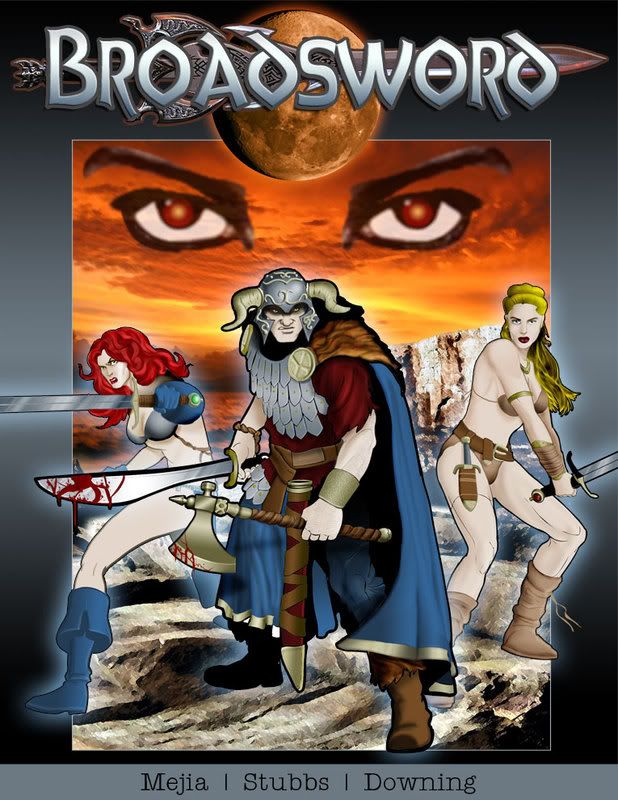
Broadsword, by Mejia, Stubbs, and Downing is campy barbarian goodness in its purest form. Reading it I couldn't help but feel like I had Robert E. Howard and David Gemmell peering over my shoulder with comments. And every time I started to stray, my inner gamer wanting technicalities and minutiae, I could hear them behind me, laughing, telling me that such things are for soft, civilized folk. Well, it ended up in an uneasy truce between the two sides of my inner heart, so that's why I think I need some special guests to help me do this review. I'm sure you'll recognize some of them, and they'll be chiming in throughout with their opinions.
First off, you can tell that the writers had fun making this. They knew the trope in and out, "Ride, fight, wench and kill! The walls of the Jeweled Cities of the south will tremble as you crush them beneath your heels!" announces the introduction, setting the tone for what's to come. Whatever the medium you encountered the barbarian of legend, be it old movies, pulp fantasy, or blood stained comic pages, you'll know that they tend to be a heroic reaction to the encroaching of civilization and the gluttony of those that reside in cities.
Conan: Civilized men are more discourteous than savages because they know they can be impolite without having their skulls split, as a general thing. Barbarism is the natural state of mankind. Civilization is unnatural. It is a whim of circumstance. And barbarism must always ultimately triumph.
Well, Broadsword promises plenty of skull splitting action, the faster and simpler the better. Using the 1pg system, it promises that you could cleave your way through a bunch of temple guards of cultists with a beer buzz and a head wound, and it very nearly seems that way. Rolling for stats and skills is simple and well explained, although has a significant random element that I worry might leave a player a bit less than heroic if their luck has deserted them. Or the gods have taking an interest in them. It makes for powerful roleplaying, if you have a good group for a pick-up game, though as mentioned in the introduction to rules of play, Broadsword is meant for gamers with some experience. And of course it helps not to get too attached, characters are living a dangerous life, and somewhat expendable.
Druss: What are 40 years of life if you cannot say that you lived well, compared to 40 minutes where you can say that you stood against the darkness? Remember the code,
Never violate a woman, nor harm a child.
Do not lie , cheat or steal. These are things for lesser men.
Protect the weak against the evil strong.
And never allow thoughts of gain lead you into the pursuit of evil.
If you follow it, live and die by it, then none shall hold you as less than a hero.
Overall the character creation rules are quick and solid. You're not going to be mulling over decisions of minutiae(because they aren't there), and this isn't an in depth character that you're making. The one thing that I feel is a bit weak is that there are no real examples of what your stats translate out as. For example, I would have liked to know would a reputation of 1 would make you a local village brute, as opposed to a reputation of 5 making one Khan of Khans. Rep is something very important to the barbarian genre.
Demid: That is the Cossack's road. No other can follow it. To live by the sword and die not otherwise, to endure torture, to make new paths into the wilderness. What is the reward? The minstrels will sing our names, the grandfathers in the villages will speak of our deeds, and children yet unborn will gather quietly to listen to the hero-tales. And that, my brothers, is Cossack glory!
As for the Advantages, they're fun and lighthearted. Including things such as the classic Chainmail Bikini(providing an armor bonus that goes away if your hero puts on more than a loincloth or the aforementioned bikini), and Summon Horde(also known as heading to the tavern to recruit drunks with promises of...well, you know), the one complaint is that there aren't more of them. Though I'm sure that one can convert such from another system that has a similar feature(i.e. feats or edges).
However, it feels like there were quite a few places where the designers were more ambitious than the result. We have a mechanic for rolling up money, as well as a background that increases starting cash, and yet, no prices for anything! Equipment other than weapons doesn't even show up, and as for the weapons, as I mentioned, no prices listed. Of course, survey says, as a barbarian your weapon is either A. Taken from someone who didn't need it anymore(of course they didn't, you killed them) or B. A family heirloom renowned in song and story. But it dos bother me that there isn't at least a list of common equipment and prices. The other thing is the hit location chart, telling you to take the armor value from any damage to that hit location, but there's nothing in the rules on fighting that tells you how to use it, or how to make a called shot.
The other place where you're essentially told to handwave it, is magic. What are presented are guidelines, and it'll take a pretty sharp GM to incorporate magic without having it unbalance the system. Of course, being barbarian fantasy, most of the heroes should be discouraged from using magic in the first place, leaving it to the evil sorcerers or inscrutable druids.
Bran: I am no fool to twist empty words and incantations. Now I need no spells, simply the allegiance of three hundred fickle Norsemen who are the only warriors among us who may stand the charge of legions on foot!
The scenarios provided are in some ways, the best part to capture that heroic sword and sorcery feel that the movies and comics have pounded into us. Though I wonder about the decision to have most of them belong to a single linked campaign when the entire feel of the product is short adventures with a relatively high turnover rate. But the plot lines and locations will be familiar to anyone who's encountered the genre, and they hit all the major themes. Actually the Captain's Daughter, the first of the scenarios is a particular favorite to set the tone, we have the price of honor, the evil mystic, the beautiful damsel, and above all, the debauched nature of civilization. And even if you decide not to use the 1pg rules, then it's as easy as swapping out a few stat blocks to convert it over to something else.
The artwork....Well, there's the pretty front cover illustration, and that's about it. My barbarian commenters are rather mute on this issue, art isn't something that they understand, or can fight, screw, or ride. And they also mention that it makes poor loot unless it's dipped in gold or gem studded, then it's just treasure.
I have to say however, that Broadsword isn't for everyone. It's a bare bones ruleset with 1 dimensional characters and some strange omissions. But for about $4, that's less than a sandwich and fries at a fast food place, it's chips and beer money, it's something you can easily convince yourself into paying. And if you play it even once and enjoy it, then you're more or less getting your money's worth. I think the moral here is not to expect more out of it than it is. This is not likely to replace your regular game system or long running campaign, but it does have its uses.
Kull: There comes, even to kings, the time of great weariness. Then the gold of the throne is brass, the silk of the palace becomes drab. The gems in the diadem sparkle drearily like the ice of the white seas; the speech of men is as the empty rattle of a jester’s bell and the feel comes of things unreal; even the sun is copper in the sky, and the breath of the green ocean is no longer fresh.
What it does make is a refreshing break from a long campaign. Or if you are suddenly short a plot important member. Actually one use that I think it might be especially good for is breaking in a new GM, one that has experience as a player but not much as GM. Heck, you can hand out the third page and roll up your characters while they study the rules(which shouldn't take more than 10 minutes or so). Or if you've just watched the latest sword and sorcery movie and feel a need to raze and pillage some civilized states. By the time the new batch of popcorn is done or people finish arriving you should be familiarized with the rules and ready to get into the action, something that you won't see with other systems.
If you want intricate rules and details, you won't find it here, but if you want some quick sword swinging, blood spattering, wench stealing action, then this can provide it, at a very reasonable cost. Now if you'll excuse me, I have to learn how to untie knots and escape these ropes before my guest commenters finish with the pillaging and start with the burning.
Conan, Demid, Druss, and Kull are not owned by me, and belong to their respective copywrite holders, they were just visiting...oh Crom I hope they're just visiting. They've already drunk all the ale, I just hope they get tired and try and find some wenches soon, my feet are getting numb.